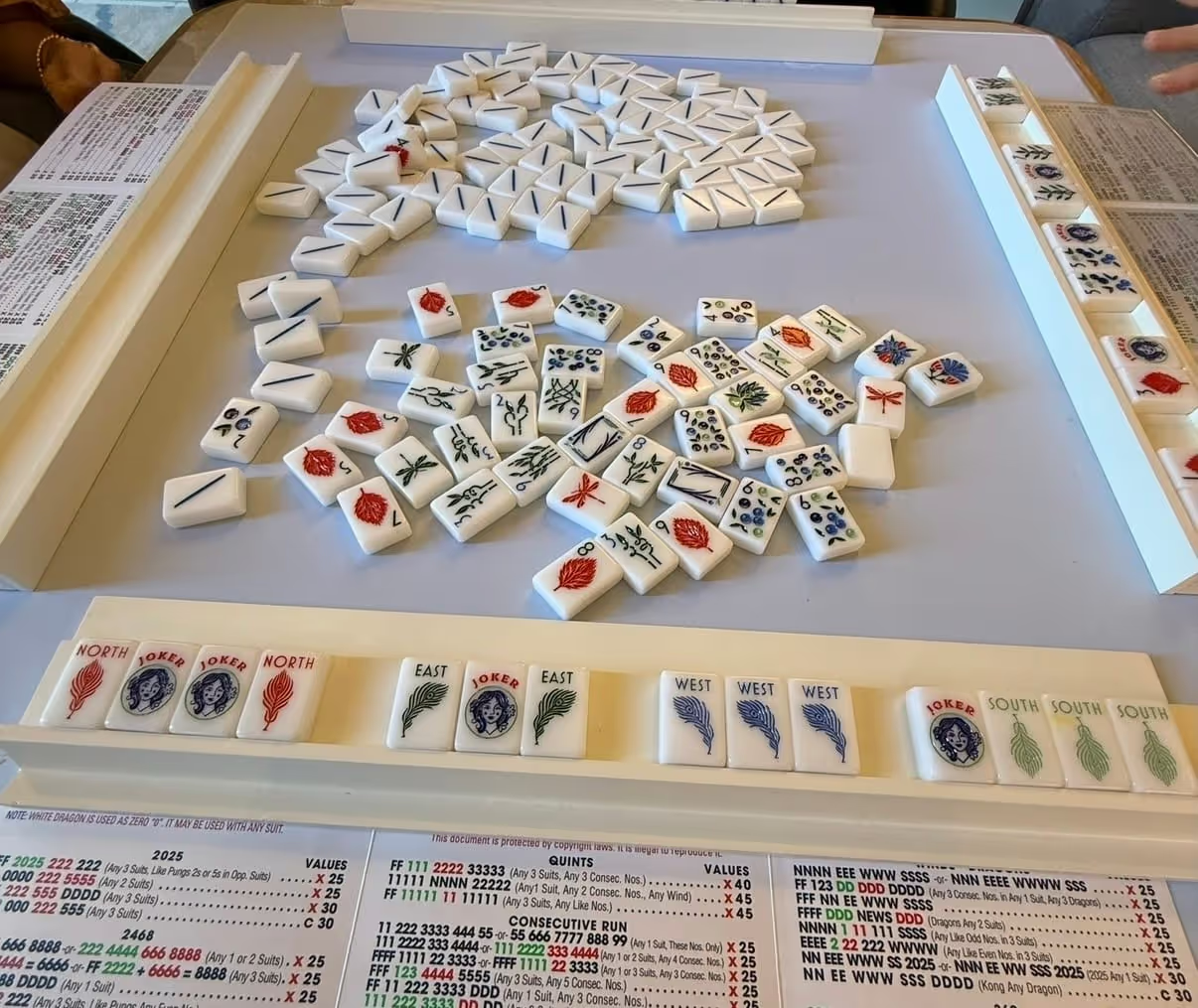
American Mahjong Tiles Explained: Suits, Jokers & More
A clear, friendly guide to every American mahjong tile: the three suits, the winds and dragons, flowers and the all-important jokers, and how each one is used.
A standard American mahjong set has 152 tiles. Most are the three suits, dots, bams and cracks, numbered one to nine. The rest are the honor tiles, the winds and dragons, plus eight flowers and, uniquely, eight jokers. Here is what every tile is and what it does at the table.
The first time you see a mahjong set opened out, it looks like a lot. It is really only a handful of families of tiles, repeated. Once you can recognize the families, the whole board reads at a glance, and the card starts to make sense. Here is the quick tour we give every new player before their first hand.
The three suits
Three suits do most of the work, and each runs from one to nine. Dots (also called circles) are marked with little rings. Bams (bamboo) show slim green sticks, and the one-bam is almost always a bird rather than a single stick, which is a lovely quirk worth knowing early. Cracks (characters) carry a red or blue number above a Chinese character.
There are four of each numbered tile, so four one-dots, four five-bams, and so on. That is 108 tiles before we add anything special, and they are the bones of nearly every hand.
The winds
Four winds, one for each direction: North, East, South and West. There are four of each, sixteen wind tiles in all. In American mahjong they turn up in plenty of hands on the card, sometimes as a run of all four directions, so they are far from decoration.
The dragons
Three dragons, in red, green and white. The white dragon is often called the soap, because it looks a little like a bar of it, and it carries a second job as a zero in some hands. Each dragon pairs with a suit, which is a connection you start to feel after a few games rather than something to study now.
(Soap)
The flowers
Eight flower tiles, usually a set of flowers and a set of seasons. Unlike other styles of mahjong, where flowers are set aside as bonus tiles, in the American game they are working tiles: many hands on the card ask for a flower or two, and they add a little grace to the set. You will hear them called simply the flowers.
The jokers
Eight jokers, and this is where American mahjong shows its own character. A joker can stand in for the tile a group needs, as long as that group is three or more tiles, which makes tricky hands reachable. It cannot be used for a single tile or a pair, and once a joker is sitting in someone's exposed tiles you are allowed to swap the real tile for it. Jokers are the tiles that make the American game feel generous to beginners.
How the tiles come together in a hand
You never have to invent a hand from nothing. Each year the National Mah Jongg League publishes an official card of set hands, and your job is to build one of them from the tiles you draw and trade. The card stays open in front of you the whole game, so you are always reading, never memorizing. Knowing the tile families is what lets you look at a line on the card and see, quickly, how close your rack really is. If the card itself looks daunting, do not worry: we walk through exactly how to read the American mahjong card in plain English.
A few things people often ask:
How many tiles are in an American mahjong set?
A standard American set has 152 tiles: 108 numbered suit tiles (dots, bams and cracks, one to nine, four of each), 16 winds, 12 dragons, 8 flowers and 8 jokers. The jokers and the eighth flowers are the pieces that set the American game apart from other styles.
What are jokers used for in American mahjong?
A joker substitutes for a tile inside a group of three or more, so a hard-to-finish hand becomes reachable. Jokers cannot fill a single or a pair, and if a joker sits in another player's exposed tiles you may exchange the matching real tile for it. Eight jokers come in a standard set.
Do I need to learn all the tiles before a lesson?
Not at all. Please do not study beforehand. At a lesson your host introduces each tile in the flow of a real game, so you learn them by handling them rather than from a page. Most people can tell the families apart within their first hour at the table.
The tiles are also, simply, lovely objects, and half the pleasure of the game is holding them. We wrote more about that in In Praise of a Beautiful Tile. When you are ready to see how it all fits together at a real table, the easiest way in is a beginner lesson: we bring the whole set to you and teach you hands-on, no studying required, and you will likely find the people around the table matter as much as the tiles do.
We teach American mahjong across the South Denver Metro, with in-home beginner lessons in Highlands Ranch, Lone Tree, Littleton, Parker and Centennial. Brand new to the game? Our start-here beginner tier is built for people who have never touched a tile. See how a lesson works and book yours.
Courtney Colclough
August 30, 2026
Find your people
Your first lesson is just a booking away, at home or at a public open session. Everything provided, hosted and never lectured.