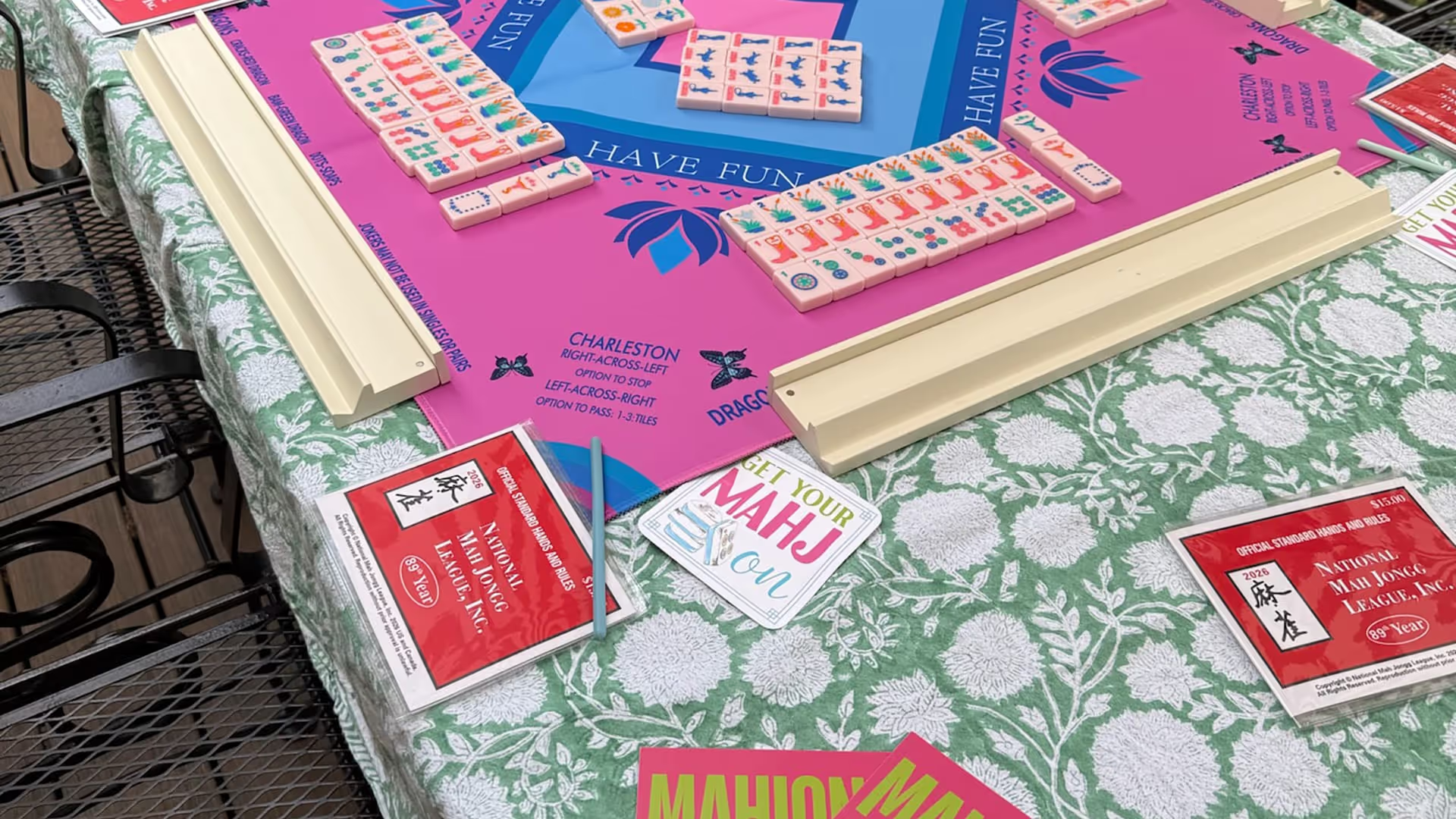
How to Read the American Mahjong (NMJL) Card
A plain-English, no-intimidation guide to reading the American Mahjong (NMJL) card: what it is, how a line works, why it changes each year, and how fast it clicks.
If you have peeked at an American Mahjong card, you probably had the same reaction almost everyone does. Rows of numbers, tiny colored symbols, letters you don't recognize yet, and a quiet little voice going there is no way I am ever reading this.
The American Mahjong card lists the winning hands you are allowed to build, grouped into sections. You read one line at a time, left to right: the pattern of tiles it wants, which suits and colors go where, and the points it scores. The National Mah Jongg League publishes a new card each year, so the hands are refreshed annually. The good news is that the card looks far scarier than it is.
Once someone shows you how a single line works, the entire thing turns from a wall of code into a menu of hands you get to choose from. So let's take the intimidation off the table.
What the card actually is
The American Mahjong card is published each year by the National Mah Jongg League, the organization that governs the American version of the game. Think of it as the official menu of legal winning hands for that year. Every hand you are allowed to complete is printed on it, and your job during a game is simply to pick one of those hands and build toward it with your tiles.
That is genuinely the core idea. You are not memorizing a rulebook. You are reading a menu and deciding what you want to make.
The card is a small folded booklet you keep beside you the entire game. Everyone at the table has one. Nobody plays from memory, beginners and lifelong players alike keep the card open in front of them, so there is no secret knowledge you are missing. If you can read a restaurant menu, you have the skill this takes. It helps to know your tiles first, and if you are still learning them, our guide to American mahjong tiles explained covers every suit, wind, dragon, flower and joker.
How to read a single line
Every winning hand is one line on the card, and every line follows the same simple logic. Once you can read one line, you can read all of them, because they are all built the same way. Here is how to work through a line, in plain English:
An example line, read left to right
- The shape. A line is just a few small blocks, read left to right — here, four of them, then the score.
- The year. The current year sits in its own block. Here it is 2–0–2–6, with the 0 written as the Soap tile.
- Color is the suit. The green threes must all be one suit; the pink threes must be a different suit. Same color means same suit, and a different color means a different one. That is all the color is telling you.
- Exposed or concealed. The letter at the end — X for exposed, C for concealed — tells you whether you may lay your groups face-up or must keep them hidden until you win.
- The points. Every line prints its score at the end. This one is worth 30.
- Look at the shape first. A line is a pattern of tiles grouped together, read left to right. You are looking at how many tiles cluster together and in what order, not doing math. The groupings are the shape of the hand.
- Read the numbers and symbols as instructions. The digits, suit symbols, and letters tell you which tiles fill each group. A run of the same digit means matching numbers. A letter stands for a special tile type. It is a recipe, and the ingredients are your tiles.
- Mind the colors. The card uses color to tell you whether groups must be in the same suit or different suits. Matching colors mean same suit, different colors mean you need different suits. Color is one of the fastest things to learn and one of the most useful.
- Check the points at the end of the line. Each hand is worth a set number of points, printed with the line. Harder hands are usually worth more. When you are new, you do not chase points, you chase the hand that best fits the tiles already in your hand.
- Pick the line that suits your tiles, not the other way around. This is the real skill, and it comes with play, not memorization. You glance down your options, see which winning hand you are closest to, and steer toward it.
That is reading the card. Five habits, and the fifth is the only one that takes real table time. The other four click almost immediately once a patient teacher points at a line and walks you through it once.
Why the card is refreshed every year
Here is the part that surprises newcomers. The card is not permanent. The National Mah Jongg League reviews and reissues it each year, with a fresh set of hands, so the game stays interesting and the challenge keeps evolving. Longtime players look forward to the new card the way a reader looks forward to a favorite author's next book.
For a beginner, this is far less daunting than it sounds. You do not learn a card by heart and then panic when it changes. You learn how to read any card, which is a skill that carries over completely from one year to the next. Learn the logic once, and every future card is just a new menu you already know how to order from.
The honest truth about the card
Let's be straight with each other, because it is the most reassuring thing anyone can tell you.
Reading the card is the one genuinely new skill in American Mahjong. Almost everything else, the shuffling, the drawing, the discarding, the rhythm of a table, is intuitive and picks up in minutes. The card is the single thing that looks like a barrier when you are staring at it alone at your kitchen table.
And it is exactly the thing that dissolves the moment someone sits beside you and reads a line out loud with you. What feels impossible solo feels obvious with a teacher pointing and explaining. Most beginners start reading lines sooner than they expect, and grow comfortable over a few unhurried sessions, at their own pace. There is no age that is too late to learn, and no number of lessons you are supposed to need. And by an hour or two in, the people around the table matter more than the card does, that is the part nobody warns you about. The card stops being a puzzle and starts being the fun part.
This is the honest reason a real teacher beats a video or an app. An app cannot see your tiles, cannot point at the line you are closest to, and cannot say "no, look, you're one tile away from this one." A patient person beside you can, and that is the whole difference between staring at the card and reading it.
How we do it at Mahjong Standard
We teach American Mahjong in homes across South Denver, and we bring the whole table to you, the tiles, mats, racks, and the current year's card, plus a beginner guide to keep. When we teach, the card is the first thing we make friendly, because once it clicks, everything else is just playing.
You do not sit and listen to a lecture. You have the card open, your tiles in front of you, and someone beside you reading lines with you until they make sense, which happens faster than you would ever guess. We run in-home beginner lessons across the South Denver Metro, including Highlands Ranch, Lone Tree, Parker, Littleton and Centennial, plus a public open session if you would rather not host.
Learn the game. Find your people.
Ready when you are: book your first lesson, read more about the American game we teach, or see how lessons work.
Frequently asked questions
How do you read the American Mahjong card?
You read one line at a time, left to right. Each line is a winning hand: its shape shows how the tiles group, the numbers and symbols tell you which tiles fill each group, and the colors tell you whether groups must be the same suit or different suits. The points for that hand are printed at the end of the line. You choose the line that best matches the tiles you already hold.
What is the NMJL card?
It is the official card of legal winning hands published each year by the National Mah Jongg League, the body that governs American Mahjong. Every player keeps a copy beside them during the game and builds toward one of the hands printed on it. It is essentially the menu of hands you are allowed to make that year.
Why does the mahjong card change every year?
The National Mah Jongg League reviews and reissues the card annually with a fresh set of hands, which keeps the game evolving and interesting for players. Beginners do not need to worry about this, because you learn how to read a card rather than memorizing one specific card. That skill carries over to every future card.
Do I have to memorize the card to play?
No. Every player, from a first-timer to someone who has played for years, keeps the card open in front of them the entire game. Nobody plays from memory. Reading the card fluently, not memorizing it, is the actual skill, and it comes with a little play.
Is the American Mahjong card hard to learn?
It looks harder than it is. Reading the card is the one genuinely new skill in the game, and it is the thing that clicks fastest when a patient teacher reads a line with you rather than leaving you to decode it alone. Most beginners start reading lines sooner than they expect, then grow comfortable over a few unhurried sessions, at their own pace.
Courtney Colclough
August 29, 2026
Find your people
Your first lesson is just a booking away, at home or at a public open session. Everything provided, hosted and never lectured.